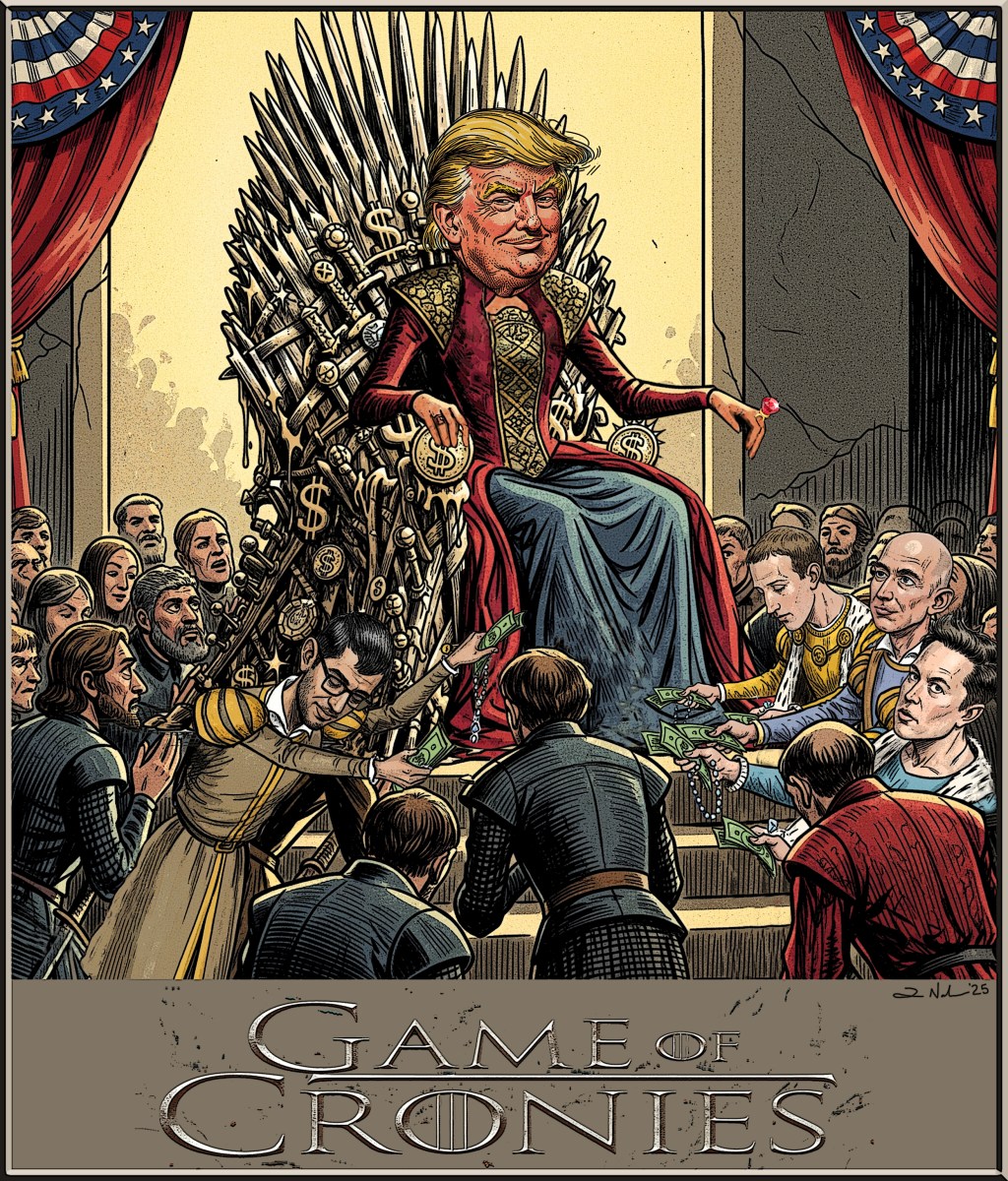
Donald Trump raised a record-breaking $239 million for his second inauguration, yet hosted fewer and smaller inaugural events than his predecessors. Where did the money go?
Donald J. Trump was sworn in as president of the United States for the second time on January 20, 2025. His inaugural committee raised a record $239 million. This amount more than doubled his take for the 2017 inauguration, and almost quadrupled the amount raised for Biden’s 2021 inauguration. Where did this money come from? Why and how was so much money raised? Where did it go? (Hint: Most of the funds went into Trump’s pockets.)
This is the second in a monthly series of articles on Trump’s corruption during his second term in office.
The inaugural budget
Presidential swearing-in ceremonies are paid for by all of us through the federal budget. The balls, concerts, candle-lit dinners, and other fancy doings that take place around the inauguration are funded through a committee established by the incumbent president. The inauguration committee must provide a report within 90 days of the event, summarizing where the funds raised by the committee came from and their disposition.
A May 2025 article by the Campaign Legal Center, a non-profit organization, commented: “Unlimited spending in inaugural funding poses a clear risk of corruption: With virtually no rules or limits on how inauguration funds can be spent, they are ripe for abuse.” Aside from a list of donors, the size of their donations, a prohibition of donations from foreign individuals and entities, and a very broad, minimally documented description of how the funds were used, the financial report provides very little accountability. Hence, it’s an almost perfect opportunity for an unscrupulous president-to-be to siphon off a huge chunk of money for his or her own personal use.
Where did almost a quarter of a billion dollars come from for Trump’s 2025 inauguration?
The short answer is mostly from large U.S. corporations and wealthy individuals. Here’s a little more on the why and the how.
Trump has publicly stated that he was surprised by, and unprepared for, his win over Hillary Clinton in 2016. Thus, his inauguration committee was able to raise “only” a little over $100 million by January 20, 2017.
Trump and his team were much better prepared for victory in November 2024, and they, including his inauguration committee, hit the ground running. In addition, corporate leaders and other wealthy individuals were well aware by then, based on his first term in office, of Trump’s “transactional” approach to the presidency and his vindictiveness toward his perceived enemies. To curry favor and/or be on his good side, they were willing to kick in big bucks for his inauguration.
Especially noteworthy is an April 2025 article in Public Citizen, a nonprofit consumer advocacy organization, that “cross-referenced new inauguration donor data . . . with corporations listed in [its] Corporate Enforcement Tracker database.” Public Citizen “found 58 corporations which include crypto companies, oil and auto industries, Big Pharma, tech companies, Wall Street hedge funds and more, [that] faced at least 88 federal enforcement actions when Trump took office. Cases against 11 of these corporations [had] already been dismissed or withdrawn, and six [had] been halted” when this article was published.
In May 2025, The Washington Post reported that “[t]he top three individual donors to Trump’s inaugural committee . . . were nominated for political appointments in his administration.” Warren Stephens, Arkansas investment banker and now the Ambassador to the United Kingdom, donated $4M, and Melissa Argyros, a California-based real estate investor, donated $2M and is Trump’s nominee to become the Ambassador to Latvia. Jared Isaacman, a billionaire friend of Elon Musk, donated $2M and was the nominee to be the administrator of NASA until recently, when his name was withdrawn because Musk himself had fallen out of favor.
Several additional factors that emboldened Trump and his cronies to go for the jackpot in inauguration funding (and in his cryptocurrency ventures, discussed in my previous article about Trump’s corrupt presidency) included Project 2025 (“a political initiative to reshape the Federal government of the United States and consolidate executive power in favor of right-wing policies”); the flurry of executive actions taken in the first 100 days of his second term; the rapid filling of cabinet positions; and the Musk-led DOGE assault on key federal agencies and employees including in the Department of Justice. All of these actions circumvented the kind of accountability that Trump was subjected to at the beginning of his first term in office.
Where did the money go?
Steve Kerrigan, who served on both Obama’s and Biden’s inaugural committees, told CNN in an April 2025 interview that “the kind of money Trump has raised far exceeds what’s needed to underwrite inaugural events. . . . The committee for Obama’s first inauguration collected roughly $54 million—money that Kerrigan said adequately covered the costs of ‘the biggest planned political event in US history.’”
In the same article, CNN reported that “Obama’s first inaugural included 10 official balls, an expanded parade and a star-studded concert at the Lincoln Memorial. Trump’s second inauguration featured three official balls. Other Trump events included an inauguration-eve rally at an arena in Washington and a celebration, complete with fireworks, at his golf club [thus, a share of inauguration expenses being paid to one of his companies] in Sterling, Virginia.”
Based on Kerrigan’s assertion that Trump raised far more money than he needed for his inauguration expenses and the approximately 33% in inflation between 2013 and 2025, Trump could have financed his dramatically pared down set of inaugural events for about $72 million (this is a conservative estimate). If these calculations are in the right ballpark, that would leave a little under $170 million for the klepto president to put in his own pockets or toward his “presidential library”—which, in Trump’s bizarre accounting world, may amount to the same thing. Remember the Trump Foundation?—which was forced to shut its doors in December 2019, and to pay a “court-ordered $2 million [penalty] for illegally using Trump Foundation funds.”
Conclusion
Trump’s inauguration bonanza was not just a one-off event. It (and his cryptocurrency ventures) set the tone for his entire second term in office, and potentially for future systemic corruption in public office in the United States that may take decades to overcome. The articles in this column will continue to chronicle the self-aggrandizing actions of the most corrupt president in the history of the United States in the months ahead.
 Presidential Corruption