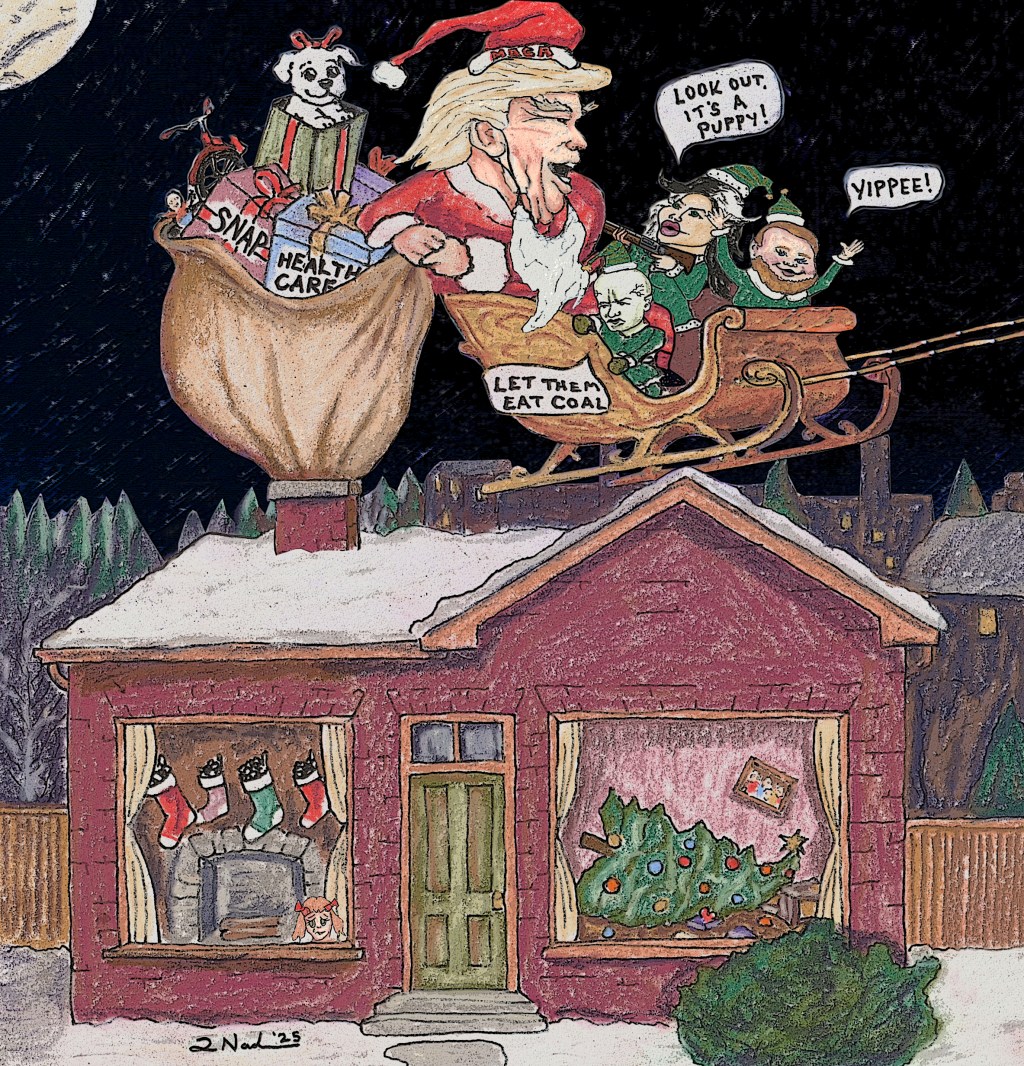
Thanks to President Trump, most Americans and tens of millions of people in other countries are getting a lump of coal (and a splash of oil and a noxious whiff of methane gas) to celebrate the end of 2025. These are not the gifts we requested in our notes to Bad Santa, nor the gifts that Bad Santa promised us prior to his election in November 2024.
As part of my monthly series of articles on Trump’s corruption during his second term in office, this one chronicles some of the goodies that Trump has bestowed on himself and his wealthy supporters and the lumps of coal he has dumped on the rest of us since his inauguration on January 21, 2025.
Unlike most of my previous articles in this series, this one focuses primarily on Trump’s “institutional corruption” rather than his “financial corruption.”
When Trump was inaugurated in January 2025, part of the ceremony included the following oath of office: “I do solemnly swear . . . that I will faithfully execute the Office of President of the United States, and will to the best of my ability, preserve, protect and defend the Constitution of the United States.” On the many occasions Trump subverts rather than preserves, protects and defends the Constitution, he is committing “institutional corruption.”
Conquest, War, Famine and Death
When Trump illegally enabled Elon Musk to take a chainsaw to many federal programs, in particular those related to foreign aid, the results have had truly horrific consequences for the world’s poorest people. Not at all the makings of a happy ending to 2025.
Conquest and War
Trump has made threats about taking over Canada, Greenland, the Panama Canal and other parts of the world. As has been well documented, he has also authorized attacks on Venezuelan and Colombian, alleged “drug boats” off of South America. These attacks have resulted in the deaths of dozens of crew members. But at least so far, he is more bombast than action when it comes to conquest and war.
Famine
The UN’s World Food Program reported in mid-October that “13.7 million . . . food aid recipients could be pushed into emergency levels of hunger [in the near future] as support is cut.” This is a result of the termination of US Agency for International Development (USAID) funding and cutbacks by other large donors.
Death and Disease
A July 2025 article in the medical journal Lancet estimated that more than 14 million people in low and middle-income countries could die by 2030 “from tuberculosis, nutritional deficiencies, diarrheal diseases, lower respiratory infections, and maternal and perinatal conditions” unless the current steep funding cuts to USAID were rescinded or replaced by other sources of assistance.
Serious, but less apocalyptic, consequences for poor and middle-income people in the United States is: Trump’s April 2 “Liberation Day,” the initiation of a global trade war.
The headline in a mid-October article published in The Guardian was “‘Empty shelves, higher prices’: Americans tell of cost of Trump’s tariffs.” The article continued: “US consumers say price rises caused by president’s tariffs contradict his promise to make life more affordable.”
As most economists predicted, raising tariffs on other countries have led to higher prices at home. High tariffs on imported goods have a similar impact to increases in domestic sales taxes. Foreign sellers can only reduce their cost of goods sold by so much. Importers can only absorb part of the cost of more expensive imported goods. Thus, eventually, consumers end up paying higher prices. According to aol.com, as of the fall of 2025, the five biggest price hikes in the United States tied to Trump’s tariffs are clothing and footwear, new cars and car parts, imported food, personal care items and energy.
The “Big Ugly Bill,” signed on July 4, ushered into law a new level of financial inequality and uncertainty in the U.S.
“New Trump Administration Policies Will Decrease Average Incomes for All Americans Except the Top 1 Percent” is the headline from an early September article published by the Center for American Progress. The article goes on to state: “New policies in the One Big Beautiful Bill Act, paired with the Trump administration’s tariffs, will leave the bottom 99 percent of Americans with less . . . income by 2027, while the top 1 percent will benefit.”
In addition, as the well-respected economist Robert Reich put it, “Trump’s cruel budget is eliminating food stamps for hundreds of thousands of Americans and reducing or eliminating health insurance for millions more by cutting Affordable Care Act subsidies and making it harder for people to qualify for Medicaid.”
A recession could begin in late 2025 or early 2026
Paul Krugman, the Nobel Prize winning economist, wrote an article with the following headline in late October: “The U.S. Economy is in Worse Shape Than It Looks: No recession so far, but the no-hiring economy is hurting workers.” The article concludes: “Many economists—actually, all the economists I know—are worried about a potential downturn. The AI boom is troublingly reminiscent of the ‘90s tech bubble.” In other words, don’t be surprised if the U.S. experiences a recession triggered by overly optimistic investments in AI-related companies.
An article published by Fortune magazine in mid-August contains the following quotation: “The odds that the economy will slip into a recession are nearly 50-50, and the time of greatest vulnerability will run from late 2025 to early 2026, according to Moody’s Analytics chief economist Mark Zandi. That’s when the impact of President Donald Trump’s tariffs and his immigration crackdown will reach their peak, he predicted.
The economy could suffer a brutal winter as President Donald Trump’s tariffs and immigration crackdown keep the U.S. teetering on the edge of recession.”
Conclusion
Not only has Trump stolen Christmas in 2025, he has set the stage for even more lumps of coal for poor and middle income people around the world and in the United States in 2026 and beyond by the increasingly autocratic and erratic approach to his presidency. Thus, there is ample evidence that Trump’s personal corruption as president has enriched himself and his family. However, his institutional corruption is likely to have a much more damaging, long-term impact on people around the world and on democracy itself in the United States.
 Presidential Corruption