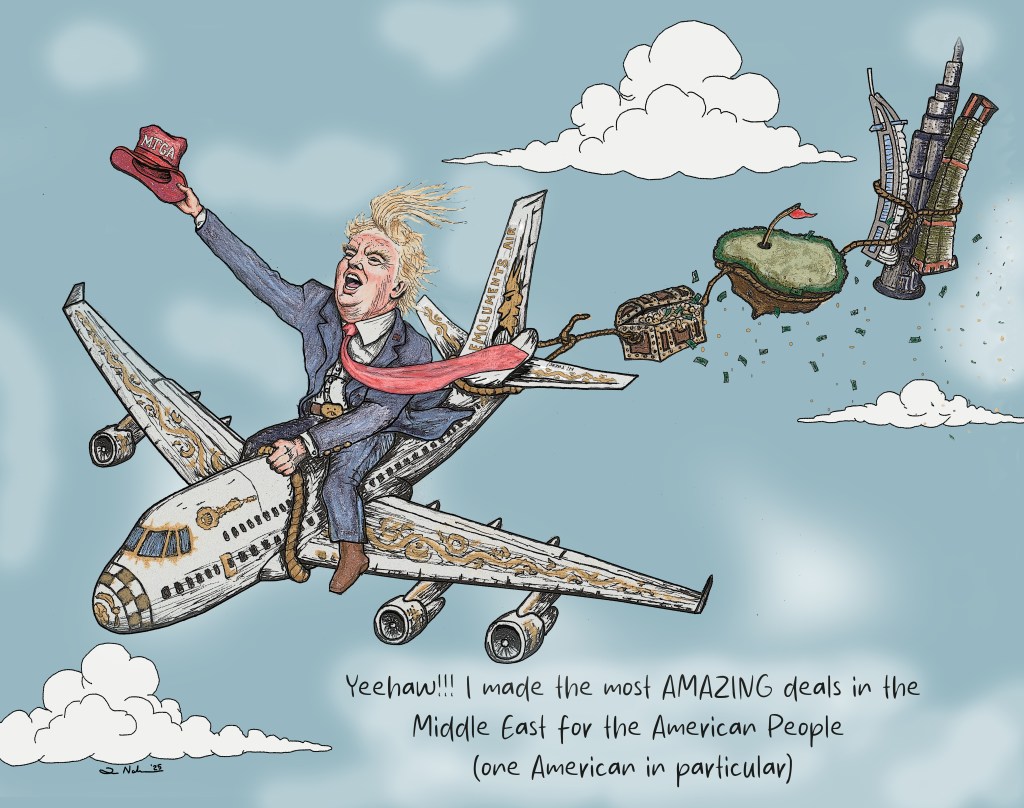
Will Trump’s Middle East tour have any benefit for the American taxpayers?
Aside from President Trump’s whirlwind trip to Pope Francis’ funeral at the Vatican in late April, the first diplomatic foray of his second term was a four-day visit to Saudi Arabia, Qatar and the United Arab Emirates (UAE) in mid-May.
In an interview with the BBC in early May, economist Karen Young stated that Trump wanted an “announcement of more Gulf money for the US … and some estimation of what [it would] do to the American economy in terms of job creation or his big push, of course, on domestic manufacturing.”
Clearly aware of Trump’s sense of self-importance, his royal hosts gave him royal welcomes. A second BBC article on May 20 reported that “Escorts of fighter jets, extravagant welcoming ceremonies, a thundering 21-gun salute, a fleet of Tesla Cybertrucks, royal camels, Arabian horses, and sword dancers were all part of the pageantry. The UAE . . . awarded Mr. Trump the country’s highest civilian honour, the Order of Zayed.”
Official meetings and results
There was serious deal-making as well. He met separately with leaders of each country and attended a joint meeting with the Gulf Cooperation Council, consisting of the three host countries plus Kuwait, Bahrain and Oman. The GCC members plus the United States own approximately one-third of all the oil reserves in the world.
According to a White House announcement released on May 16, “President Donald J. Trump’s first official trip was a huge success, locking in over $2 trillion in great deals—including a $600 billion investment commitment from Saudi Arabia, a $1.2 trillion economic exchange agreement with Qatar, $243.5 billion in U.S.-Qatar commercial and defense deals, and $200 billion in U.S.-United Arab Emirates commercial deals.”
According to the second BBC article, “[T]here remains some doubt as to whether those investment figures are realistic. During his first term in office from 2017 to 2021, Trump had announced that Saudi Arabia had agreed to $450bn in deals with the US. But actual trade and investment flows amounted to less than $300bn between 2017 to 2020, according to data compiled by the Arab Gulf States Institute.
“The report was authored by Tim Callen, the former International Monetary Fund (IMF) mission chief to Saudi Arabia, and now a visiting fellow at the Arab Gulf States Institute.
‘The proof with all of these [new] deals will be in the pudding,’ says Mr. Callen. . . .
“As well as the challenge of delivering what is promised, another potential obstacle to these figures being realised are oil prices.
“Oil prices tumbled to a four-year low in April amid growing concerns that Trump’s tariffs could dampen global economic growth. The decline was further fueled by the group of oil producing nations, Opec+ , announcing plans to increase output.”
On August 4, Reuters reported on yet another OPEC+ oil output increase, thus further decreasing oil income per barrel.
Trump’s personal financial benefits from the trip
Not surprisingly, given the self-enriching priorities of this president, the Middle East trip was also about advancing his and his family’s wealth.
In February, The New York Times, enumerated the large and growing economic portfolio of the Trump family in the region. The upshot of the article is that “The Middle East has in the past three years turned into the hottest spot for the Trump family in terms of new international real-estate deals.” These deals have included luxury apartment buildings, golf courses, and hotels, as well as partnering with LIV Golf, financed by Saudi Arabia’s sovereign wealth fund. “LIV Golf pays the Trump family to host [an annual tournament at the Trump National Doral near Miami] . . . , which also drives thousands of customers to its restaurants and hotel rooms during the weekend event.”
On May 1, Reuters published an article entitled, “Trump’s stablecoin chosen for $2 billion Abu Dhabi investment in Binance, co-founder says.” Senator Elizabeth Warren is quoted in the article as saying “. . . [T]he Senate is gearing up to pass . . . stablecoin legislation that will make it easier for the President and his family to line their own pockets. This is corruption and no senator should support it.”
On May 25, the Washington Post quoted Trump as saying “[I] got a beautiful big magnificent free airplane for the United States Air Force. . . . Very proud of that.” But there is a lot more to the story. CNN reported that Trump initiated a request to the Qataris for the plane, estimated in other reports to be worth between about $200 million and $400 million. Thus, it was not a gift, in the traditional sense of the word—perhaps “sheikh-down” would be more accurate. Secondly, in a July 27 article, the New York Times cited anonymous Air Force officials as admitting that over $900 million has already been set aside for upgrading the plane for use as Air Force One. The Post article cited above reported that Qatar is likely to donate the plane “initially to the U.S. government and then later to the Trump Presidential Library Foundation once Trump [leaves] office.”
In short, Trump appears to have pressured Qatar to “gift” a $200-400 million plane to the U.S. Air Force, which will in turn use over $900 million in US taxpayer money to upgrade the plane, and then hand it over to Trump’s “Library Foundation” (whatever that is) after he leaves office. What a deal! A few hundred million here and there is camel fodder in relation to a “$1.2 trillion economic exchange agreement” with Qatar. However, the self-dealing built into international agreements like this sets a bad precedent for the long-term future of American international trade.
Conclusion
In the Trump era, self-enrichment is a driving force of both domestic policy-making and international diplomacy. Diplomacy on behalf of the interests of the United States has begun to shift to diplomacy on behalf of the President and his allies. There are numerous examples worldwide—from Zimbabwe’s Robert Mugabe to the Marcos family in the Philippines to the royal families in the Middle East—of autocrats enriching themselves at the expense of their own countries’ well-being. The playbook is familiar, and the effects this kind of corruption has on the democratic institutions of the home country are, unfortunately, predictably dire.
 Presidential Corruption