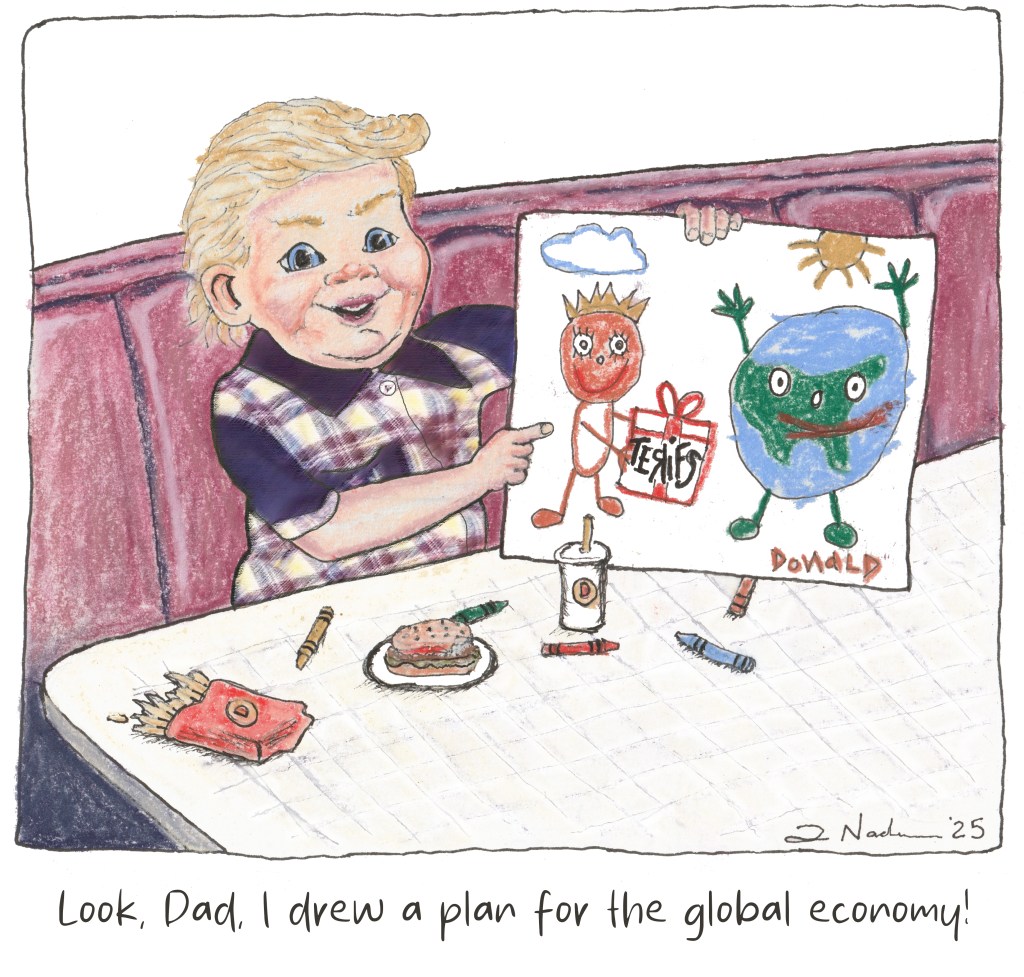
With very few exceptions, my answer is “No.” The exception? The opportunities for Trump “insiders” to line their pockets.
I was going to dismiss the above question with a quick “No.” But when Trump imposed a 50% tariff on India in early August to deter it from buying cheap oil from Russia, I decided that the question needed a more nuanced answer. A tariff can serve as a form of sanction by one country against another in an attempt to change the latter country’s behavior. In the case of India, however, the increased tariff seems to have had the opposite effect.
So, with very few exceptions, my answer is still “No.” This article looks into the negative impacts of Trump’s tariff “policies,” describes the damage that his chaotic tariff roller coaster is doing to international trade and people’s lives and summarizes opportunities for corruption that this chaos has created for him and his “insiders.”
Paul Krugman, a recipient of the Nobel prize for economics in 2008, recently described the problem succinctly: “Trump’s whole trade war is based upon a deluded version of how the world economy works.”
Trump attended the prestigious Wharton School of Economics. But how he got in, what he learned there, and how he graduated remain a mystery. Even his grade point average while there is not public information.
In his first introductory class, he should have learned things like:
- The price of goods and services varies with their supply and demand.
- Markets hate uncertainty.
- The current global trading system operates fairly smoothly, based on decades of trial and error.
- If it ain’t broke, don’t fix it.
But Trump’s infatuation with imposing tariffs on the rest of the world as a means of strengthening the U.S. economy—particularly by adding U.S. manufacturing jobs—was not derived from his course curriculum at Wharton.
Raising, Lowering, Threatening
Trumponomics is not just comprised of the U.S. increasing tariffs on countries around the world, but also on unpredictably raising and lowering tariffs and threatened tariffs. Since his so-called “Liberation Day” on April 2, 2025, nobody (including Trump) has had any idea from day to day what U.S. tariff rates would be threatened, imposed, increased or decreased on any particular country or uninhabited island.
As mentioned above, markets hate uncertainty; Trump’s tariff craziness has given world economic growth projections a severe case of the willies, and U.S. projections an even more severe case. As of the end of July, the International Monetary Fund projected a 10% decline in world economic output in 2025 compared to 2024 (a growth rate of 3% in 2025, down from 3.3% in 2024). For the U.S., the projected damage to growth is even more dramatic—a 32% decline (1.9% in 2025 down from 2.8% in 2024).
I hasten to add that numbers are just numbers. In poor countries, slower growth impacts tens of millions of real people who are living on the margins of survival. In the U.S., the Yale Budget Lab calculated on August 7 “an average per household [annualized] income loss of $2,400 in 2025” resulting from rises in tariffs—in most cases not life-threatening, but nonetheless painful for poor and middle class residents.
Worse Things Coming?
According to CNBC, the worst impacts of Trump’s tariff madness are yet to come. The primary reasons for these delayed effects are that importers stocked up on items prior to the imposition of the tariffs and now are gradually passing the higher costs on to consumers. Thus, in the long run, tariffs will effectively be a tax on U.S. consumers.
Another Trumpian trade delusion is that somehow his trade “policies” will bring about a resurgence of manufacturing activity in the United States. This is highly unlikely, especially in the short run. Much U.S. manufacturing has been outsourced to other countries where labor costs are cheaper. This is especially true in textile manufacturing. By local standards, textile workers in Bangladesh or Lesotho receive an adequate wage, but in the United States wages for these jobs would be well below the poverty line.
The U.S., Canada and Mexico have developed an intricate multi-country process for manufacturing automobiles, with the production and assembly of parts for the same vehicles occurring across the three countries. Trump’s tariffs on Canada and Mexico have disrupted this manufacturing model and are costing rather than creating jobs.
Many other examples of well-functioning trade agreements, including those involving manufacturing and service components, among the U.S. and other countries have been thrown into turmoil by Trump’s chaotic approach to international trade.
All of these problems and we haven’t yet gotten to the related corruption issues. Don’t worry (or rather, I should probably write, “Worry!), these issues are up next.
How Trump’s tariff “policies” foster corruption
Economics 101 also tells us that abrupt changes in the price of goods and/or services cause turmoil in the price of affected stocks and stock markets. Those with insider knowledge about upcoming changes can make big money on buying or selling ahead of other investors. Such insider trading is illegal.
Trump announced that April 2, 2025, would be “Liberation Day,” initiating changes in U.S. global tariffs. Most investors and countries were caught by surprise by the extent of these tariffs, announced after U.S. stock markets were closed for the day on April 2. U.S. stock prices plummeted in afterhours trading.
But some investors made money as a result of Trump’s post trading-day announcement. For example, Pam Bondi, the U.S. Attorney General, sold more than $1 million in Trump Media stock (60% owned by Donald Trump), appearing to have cashed in on insider knowledge in advance of the upcoming drop in the stock’s value.
Then, on April 9, Trump announced a 90-day pause on tariff increases (except for those imposed on China). This announcement caused a surge in U.S. markets up about 10% for the day. Who among Trump’s family, cabinet members and cronies knew about (and acted on) their advanced knowledge of this market-shaking news? We may never know.
Similarly, the U.S. and Japan agreed to a trade deal on July 22. Trump announced the agreement that evening in Washington D.C. Late on the 22nd, a CNBC article reported that “Honda stock jumped more than 11%, while Toyota surged over 15%. Nissan jumped over 9%, and Mazda Motor surged over 17%. Mitsubishi Motors popped over 13%.” Was there insider trading in advance of these huge price increases? Probably. But it would be a difficult thing to prove, especially during the Trump administration in the United States, where the foxes are “guarding” the chickens.
Justice may yet be served
An article published on September 3 by the Brennan Center for Justice stated that “The shape of the big showdown on presidential power is now coming into view. Two appeals courts in the past few days have issued resounding rulings that many of President Trump’s high-profile moves on tariffs and immigration were illegal. Both cases will soon head to the Supreme Court.”
Thus far during Trump’s second term, the Court has “squirmed and wriggled to avoid confronting the White House … These cases, though, will now be fully briefed and argued on the merits, heard in the bright spotlight of public attention.”
Also, there are various statutes of limitation for different kinds of securities fraud, ranging from 5 to 10 years. Thus, in the post-Trump era, and with a Democratic president and congress, some who profited off of insider trading during Trump’s second term in office may yet be convicted and imprisoned.
Right now, we know very little about who has benefited from insider trading under the Trump administration. This is by design. Corruption festers in the dark and keeping Americans in the dark is a hallmark of Trump’s second term and of the blueprint laid out in Project 2025. Until now, we have had both a cowed Congress and a supplicating justice system. Perhaps, one or both of those forms of appeasement are about to change.
 Presidential Corruption