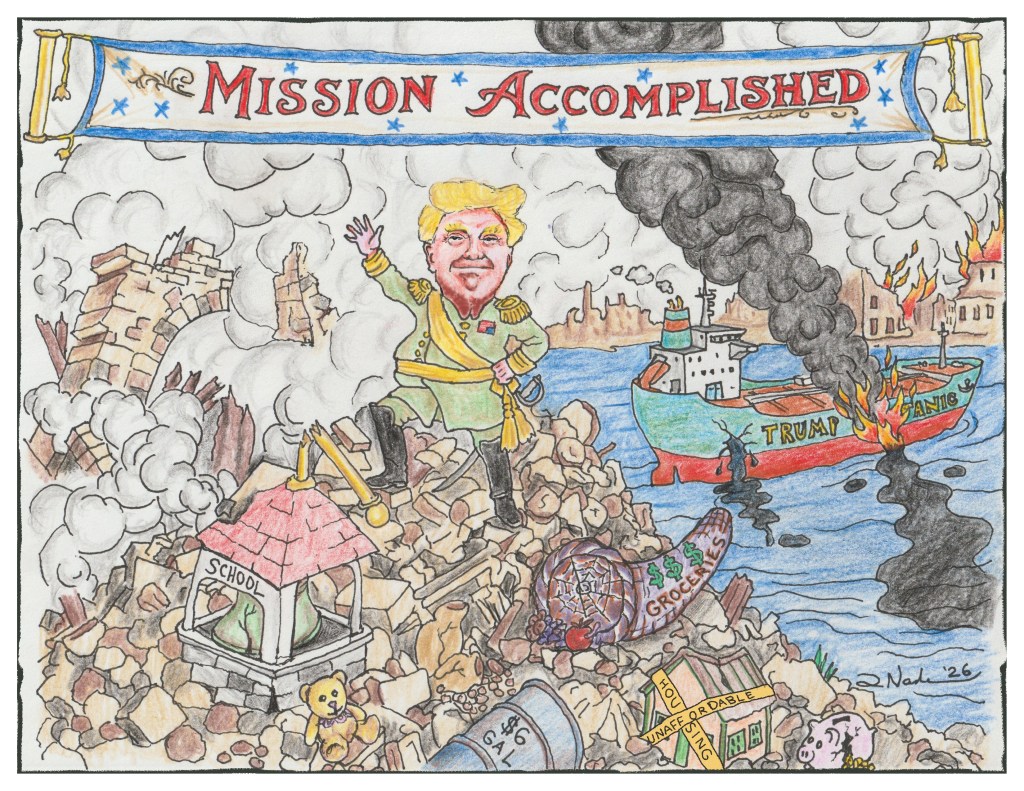
Undelivered promises for American prosperity in 2025 and a war with Iran in 2026 he promised would never happen.
In many ways, we live in two Americas: one inhabited by a tiny fraction of the population who have immense wealth, pay very few taxes and have highly disproportionate political influence. Most of the rest of us have enough money to get by through our jobs, social programs and health insurance, but can’t take any of these sources of income and support for granted.
During Trump’s second term in office, the ultrarich have gotten richer and more powerful; most of the rest of us have experienced an increase in the cost of living and a decrease in our political power. This article, one of a series on corruption during the second Trump administration, focuses on the rot in Trump’s economics that is harming “the rest of us.”
Effects of Trump’s Economic Policies on “the rest of us”
Early this year, the New York Times compared Trump’s economic campaign promises in 2024 with what actually happened in 2025. Trump promised to lower food prices and energy costs. They both increased instead. The Budget Lab at Yale estimated that Trump’s new tariffs increased the average cost of living by roughly 1.7% in the short run. This increase in consumer prices represents an average household purchasing power loss of approximately $2,300 to $2,800 in 2025.
In January 2026, the American Association of Retired Persons (AARP) warned that prices for many goods and services—for example, health, auto and home insurance, utilities, clothes and footwear, smart phones and computers—were likely to continue to increase in 2026. Housing has been cited by many as another stubborn cost that is likely to keep rising in 2026.
As reported by PBS in mid-March 2026, during his campaign speeches in 2024, Trump promised that the tariffs he planned to impose on other countries around the world “would force more factories to open in the U.S. and would generate enough revenue to close federal budget deficits.” In fact, The Joint Economic Committee – Minority Report, released on February 11, 2026, showed that the manufacturing industry lost 108,000 jobs during the first year of President Trump’s second term. There was a slight increase in manufacturing jobs in the first quarter of 2026, but not nearly enough to offset the 2025 job loss.
In summary, the effect of Trump’s economic policies was to increase the cost of living in 2025 and early 2026 for most Americans, not to decrease it. So, he deserves a grade of F on his economics report card. And he “earned” that failing grade before he and the Israelis launched the war on Iran on February 28, 2026.
Economic Consequences of the Iran War
The Motley Fool projects that a major result of this war will be to raise world and domestic oil prices and their byproducts dramatically in 2026 because of Iran’s ability to close the Strait of Hormuz, through which over 20% of the world’s oil is shipped.
Gasoline, diesel and jet fuel are made from crude oil. Much of the world’s supply of fertilizers has also been dramatically curtailed by the closing of the strait. As the cost of crude climbs, so do the prices of these widely used products, which keep equipment, cars, buses, delivery trucks and airplanes running and our agricultural crops growing.
The BBC reports that the average price of gasoline in the United States in early April was over $4 per gallon, 25% more than it was just before the war. Higher gasoline prices significantly increase the cost of living by directly boosting transportation expenses and indirectly raising the cost of goods, as nearly all products rely on fuel for transportation. This inflationary pressure acts like a regressive tax, disproportionately straining lower-income families.
As Time Magazine put it, “For ordinary American families, the impact of the war in Iran will not be a single price spike, but rather a rolling series of shocks that will hit their wallets at every turn.”
Beginning in April, according to a CNBC report, “Moody’s Analytics model has raised its recession outlook for the next 12 months to 48.6%. Goldman Sachs boosted its estimate to 30%. Wilmington Trust has the odds at 45%, while EY Parthenon has it at 40%, with the caveat that ‘those odds could rapidly rise in the event of a more prolonged or severe Middle East conflict.’”
Conclusion
So, what do we conclude from Trump’s undelivered economic promises in 2025, and the unanticipated war he delivered in Iran in 2026? Not to mention the economic and other hardships these combined sets of actions and inactions have wrought on the American people and those of the rest of the world.
History has shown that Trump is an inveterate liar. The Washington Post tracked over 30,000 false or misleading statements made by Trump during his first term in office. The rate of these lies accelerated during the final year of that term. A direct conclusion of such a track record is: “Doubt every word he says.”
By all appearances, Trump seems to be doubling down on his dishonesty during his second term in office, aided and even goaded on by his sycophantic and incompetent cabinet members and other enablers. In the cases of economic policy, war-mongering and other maleficent actions, we may have seen nothing yet.
 Presidential Corruption